![[personal profile]](https://www.dreamwidth.org/img/silk/identity/user.png)


Celebrating Another Year
A trip planned by my sister and I for my birthday resulted in many multi-beautiful moments for me concerning my family. But, one stand out moment, as an artist, who loves herself some color occured. On our return to DFW airport there was a thunderstorm awaiting us. I decided, to pay attention because I had never viewed one from above. I wasn't disappointed in what I viewed. The aircraft moved through it. Pink, Pink, Pink cloud it was. The sun was setting, and the clouds turned into what I perceived as a forest. I swear it could have been a watercolor. Never to late to learn a little sumpin...sumpin
One feature that is indicative of a strong/severe storm is an anvil cloud. The anvil is the elongated cloud at the top of the storm that spreads downwind with upper-level steering winds. The anvil appearance is solid, not wispy, and will have sharp, well-defined edges. An anvil cloud is made up of ice particles that form in the highest levels of a thunderstorm. The flat top you see is due to rising air in storms. The air expands and spreads out as it hits the bottom of the stratosphere (the layer of the atmosphere directly above the troposphere – where we experience our weather). The air that rises from the anvil is cooler than the air of the stratosphere. Since cool air is more dense than warm air, this prevents the air from the anvil from rising beyond the stratosphere. It is possible to see clouds that push through the flat top of the anvil. This is called an overshooting top. If the overshooting top is persistent and lasts for 10 minutes or longer, it is generally a sign of a very strong thunderstorm. It is possible that thunderstorms with an anvil and overshooting top can be seen over 100 miles away..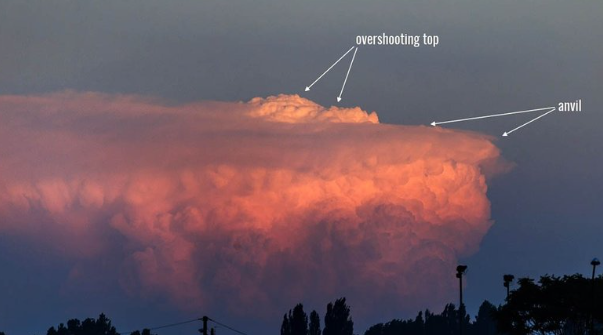 ,
,
One feature that is indicative of a strong/severe storm is an anvil cloud. The anvil is the elongated cloud at the top of the storm that spreads downwind with upper-level steering winds. The anvil appearance is solid, not wispy, and will have sharp, well-defined edges. An anvil cloud is made up of ice particles that form in the highest levels of a thunderstorm. The flat top you see is due to rising air in storms. The air expands and spreads out as it hits the bottom of the stratosphere (the layer of the atmosphere directly above the troposphere – where we experience our weather). The air that rises from the anvil is cooler than the air of the stratosphere. Since cool air is more dense than warm air, this prevents the air from the anvil from rising beyond the stratosphere. It is possible to see clouds that push through the flat top of the anvil. This is called an overshooting top. If the overshooting top is persistent and lasts for 10 minutes or longer, it is generally a sign of a very strong thunderstorm. It is possible that thunderstorms with an anvil and overshooting top can be seen over 100 miles away..
,